There is a small inland city in Tuscany — about twenty minutes by train from Florence — that the rest of the fashion world has spent two centuries trying to imitate, and never quite managing.
Its name is Prato, and almost every fine sweater you have ever loved, even the ones that don’t say so on the label, owes something to its mills.
This is the story of what really lies inside regenerated cashmere.
A craft, not a trend
The phrase regenerated cashmere is recent. The thing itself is not.
In Prato in the early 1800s, an enterprising weaver named Giovanni Battista Mazzoni faced a simple problem. Wool was expensive, the market was hungry, and the local textile economy was being slowly squeezed by larger producers in the north. He started to wonder whether the discarded woollen garments and offcuts piling up in workshops and second-hand markets across Europe might be made into something new.
The answer, after decades of experimentation, became an entire industry. By the late nineteenth century, Prato was the world’s leading centre for the regeneration of woollen fibres — a position it has, quietly and without fanfare, never relinquished. According to the city’s own textile museum, the district today reprocesses over 140 million kilograms of textile material every year.
Cashmere, when it eventually arrived in Italy as a luxury fibre, was naturally absorbed into the same process. The result is what we now call regenerated cashmere — a yarn that began life as something else, and was given a second.
What “regenerated” actually means
Regenerated cashmere is not synthetic. It is not blended with plastic. It is not a substitute for cashmere — it is cashmere, simply at a later stage in its life.
The process, in its simplest form, looks like this:
- Sorting by colour and quality. Hand-selected garments and production offcuts are sorted by shade and grade. There is no chemical re-dyeing — colour is matched at the sorting stage, which is one reason the craft is so difficult.
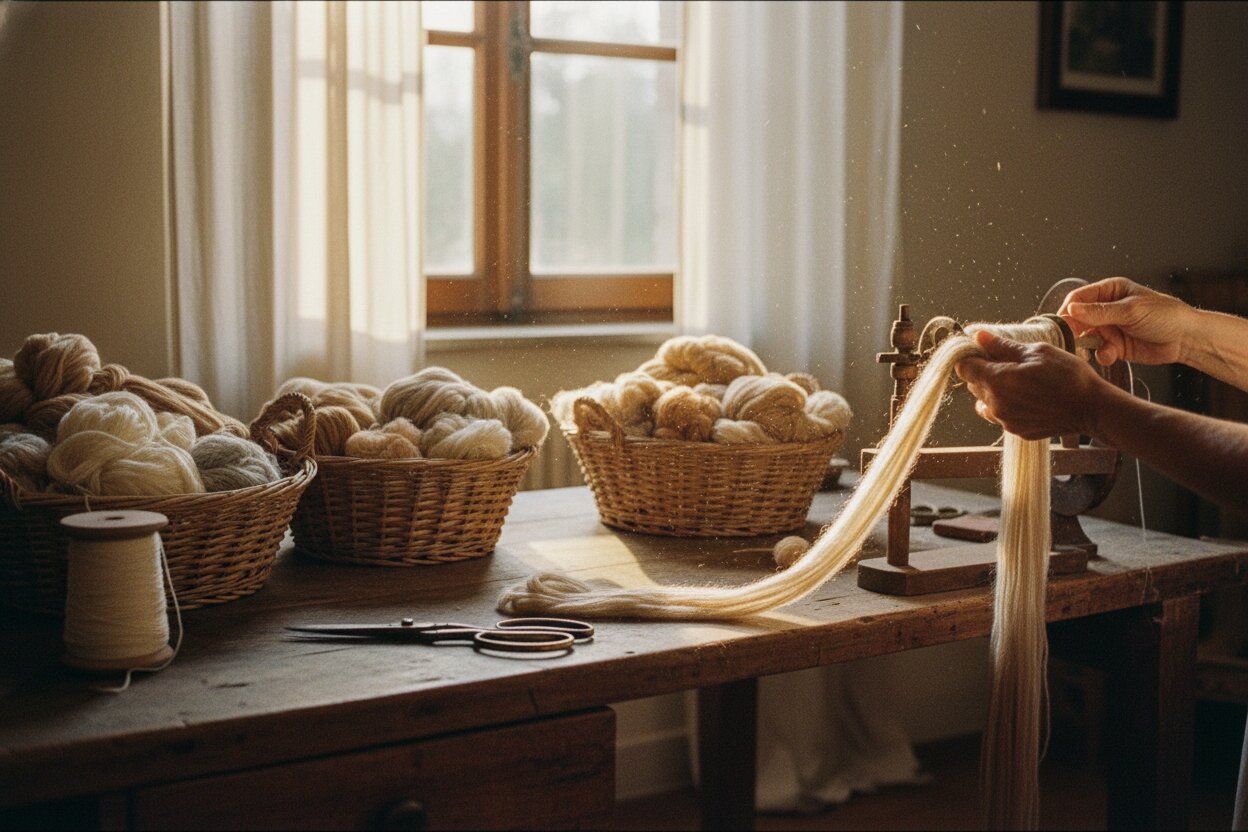
- Mechanical opening. The garments are gently shredded back into individual fibres, using specialised machinery that has been refined in Prato for over a century.
- Carding and blending. The fibres are carded into a soft web and often blended with a small percentage of virgin fibre (cashmere, merino, silk) to strengthen the staple length.
- Spinning. The blend is spun into a new yarn, ready to be knitted into a new piece of clothing.
The yarn that emerges is technically the same fibre that left a Mongolian goat years earlier — only it has lived through one or two lives in between.
Why it is harder, not cheaper
There is a quiet misconception that regenerated means cut-price. It does not.
Regenerating cashmere is more demanding than spinning virgin fibre, not less. The fibres have already been used; they are slightly shorter, slightly more delicate, and they require a more skilled hand to spin into a yarn of luxury quality.
Only a handful of mills in the world possess the expertise needed to regenerate cashmere at a level worthy of luxury knitwear. Almost all of them are in Prato.
This is why the most refined Italian houses — many of which you would never associate with “recycling” — quietly use regenerated yarns. Stella McCartney has spoken openly about it for years. Brunello Cucinelli and Loro Piana are far more discreet, but the Prato spinners they buy from have a long client list and a short tongue.
How it feels in the hand
The honest answer is: identical, when it is well done.
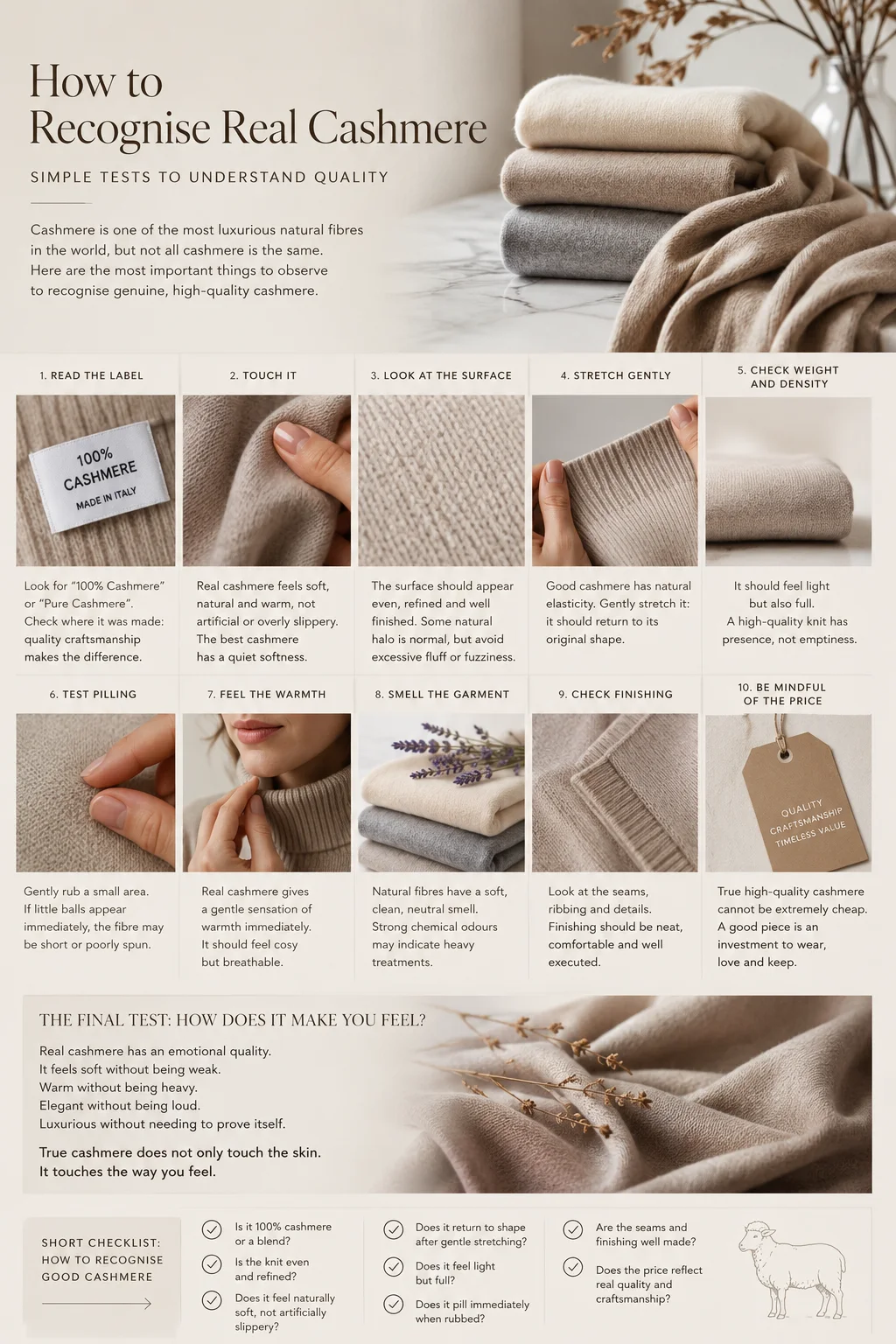
Cashmere fibres carry no memory of their previous garment. Once carded back into a soft web and re-spun, they behave exactly as virgin cashmere does. The hand-feel is as soft, as warm, as quietly luminous.
What does change — and this is the romance of it — is the story. A regenerated cashmere sweater has lived before. It carries the very faint trace of every hand and every winter it has already known. We think this gives the fibre a kind of quiet character that new yarn cannot possess.
Why we use it
At ValeriaVH we work with a single material: regenerated cashmere from Prato, spun by a small mill we have partnered with directly.
Our reasons are not sustainability buzzwords, though the environmental advantages — measured by the Higg Index, regenerated cashmere uses roughly 90% less water and 80% less energy than virgin cashmere — are real and significant.
Our reasons are older than that:
- Heritage — to continue an Italian craft that began in the 1800s, rather than start a new factory in a distant country.
- Rarity — because the fibres we work with are limited and difficult to spin, our production is naturally small. We could not be a fast-fashion brand even if we tried.
- Quality — the spinners we partner with have been refining this craft for four generations. The yarn they produce is exceptional.
- Conscience — true luxury, we believe, is not measured by what is taken from the world but by the care with which it is given back.
This is why we call our pieces The Reborn Cashmere. Not as a marketing line — but as a quiet description of what they actually are.
Reading further
If you would like to understand the heritage of Prato in more depth, the Museo del Tessuto (Prato’s textile museum) maintains a free public archive. The Lampoon Magazine longform on the regeneration district is also a beautiful starting point.
And of course, you are welcome to read our own page on The Reborn Cashmere, or explore the Private Edit made entirely from this same yarn.
A piece of regenerated cashmere is a piece of memory, gently re-spun.